
Beyond Sound: How Sign Languages Define Understanding and Translations
When people think about languages, they usually think of spoken words, written text, and communication between people. They think about teaching their kids their first words. That moment when a sound, a gesture, or a sign turns into communication we can understand. When something small suddenly takes on meaning.
In the earliest stages of human communication, meaning was shared through gesture, facial expression, and movement. These visual forms allowed people to communicate before language had a fixed structure. Over time, spoken language became more dominant, followed later by writing, which made language easier to preserve, standardize, and pass across generations. As these systems developed, visual communication faded from the center, but it never disappeared.
Sign language makes that clear. It shows that communication does not always have to depend on voices. It can also depend on shared understanding. A system that lets meaning take shape, stay intact, and move between people.
A brief history, and the pattern it reveals
For a long time, sign-based communication existed without formal recognition. It worked. People understood one another. But outside those communities, it was often treated as secondary or informal.

That started to change in the eighteenth century. In the mid-1700s, Abbé de l’Épée, a French educator, helped bring sign-based communication into formal education. He opened one of the first public schools for deaf students in Paris. He wasn’t trying to invent a new language. He recognized that deaf communities were already communicating through structured signs and worked to support and legitimize that system.
As education spread and communities grew, sign languages developed in different directions. They took on local structure, culture, and shared habits, just like spoken languages do. Today, hundreds of sign languages are used around the world.
This matters not because of the history itself, but because of what it shows. When communication systems are built around meaning, they last. When they’re treated as shortcuts or stand-ins, understanding starts to fall apart. That same pattern still shows up in modern translations more often than people think.
Complexity, structure, and why translation feels off
Every sign language has its own grammar and structure. American Sign Language (ASL), for example, is structurally different from German Sign Language (DGS). They are not mutually understandable, even though both are visual languages.
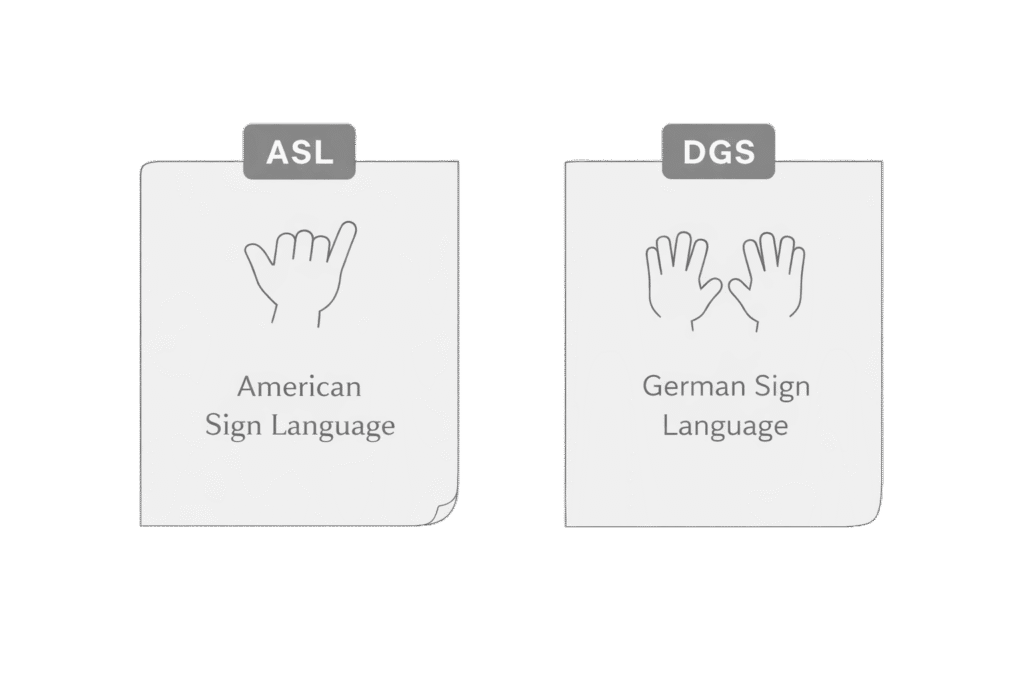
Within sign languages, there are:
- regional variations
- stylistic differences
- wordplay and metaphor
- even poetry and performance traditions
These features are not decorative. They are indicators of linguistic depth.
They show that language does not become “less” when sound is removed. It simply reorganizes itself around a different medium.
Translation is where systems meet
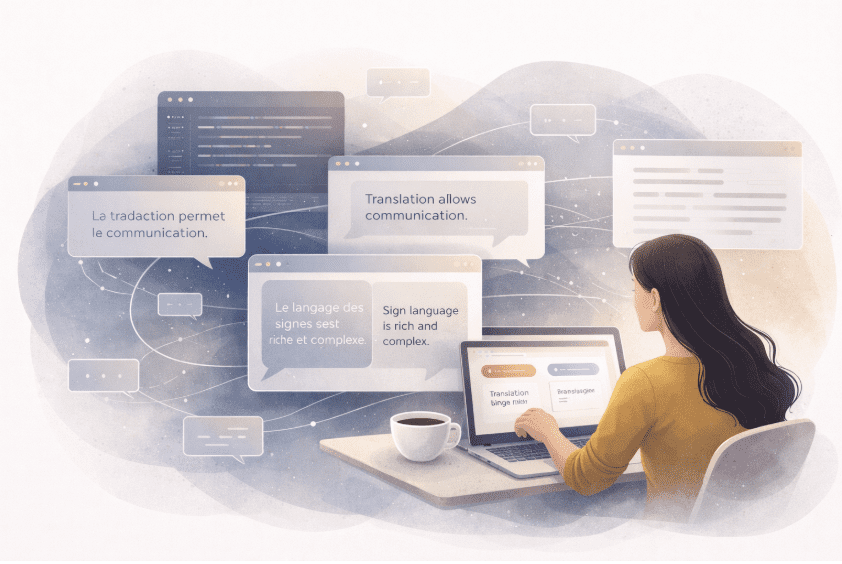
Sign languages and spoken languages operate in different ways. Translating between them is not about swapping words. It is about moving meaning across systems that work differently.
The same applies in e-commerce.
Translation touches storefronts, navigation, product descriptions, system messages, and customer trust. When these systems are not designed to support meaning, communication breaks down. Not because translation is impossible, but because the structure does not allow meaning to travel clearly.
What this means for digital commerce
In digital commerce, language is doing real work all the time. Across interfaces. Across cultures. Across markets.
For Shopify merchants, this often shows up in familiar ways. Product descriptions that don’t convert. Navigation that feels awkward in another language. Brand voice that doesn’t survive translation.
When translation is treated as an afterthought, language becomes a liability. When it is built into the system from the start, it becomes a foundation for trust.
This is where thoughtful translation tools matter.
Choosing a translation approach that fits how you grow
Not all translation solutions are built for the same purpose. Some prioritize speed. Others prioritize control. Some focus on replacing text. Others focus on preserving meaning.
Understanding this difference helps merchants make informed decisions not just about translation, but about how they want their brand to scale across markets.
At langify, this belief shapes how we build. We focus on giving merchants control over how their language is structured, reviewed, and presented. Because protecting meaning protects trust. And trust is what drives long-term growth.
Translation as shared understanding
Language has never depended on one format. It changes with the tools people use and the situations they’re in. What matters is whether the meaning makes it through.
For businesses working across languages, this isn’t abstract. Translation affects how customers read a product, how they trust a brand, and whether things feel clear or confusing once they land on your store. When language is treated as interchangeable text, something usually gets lost. When it’s handled with structure and intention, it holds together.
That’s why translation isn’t just a technical step when you grow into new markets. It’s a decision about how your brand shows up, how clearly you communicate, and how much control you want over that experience.
langify The First Translation app on Shopify – since 2014

“Business is the profession. Harmony the passion.”
Connecting people and customers is the key. In e-commerce & general. Tones & Music are a wonderful communication tool. Only 7 tones define it and are understood all around the world