
Beyond SEO: Why Multilingual Shopify Stores Need to Think About GEO in 2026
Your store is ready for SEO, but have you optimized it for GEO?
If you’re running a multilingual Shopify store in 2026, Generative Engine Optimization (GEO) might be the most important thing you’re not yet thinking about. And for international stores, it matters even more than for English-only businesses.
What is GEO?
Generative Engine Optimization is the practice of optimizing your content to appear in AI-generated answers on platforms like ChatGPT, Claude, Gemini, and Microsoft Copilot.
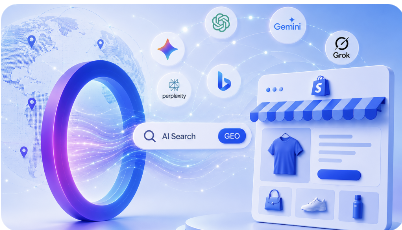
Your pages are ranked in a list of links on Google by traditional SEO. Whether your content is picked as a trusted source by an AI system is determined by GEO when an answer is generated directly for a user, without them ever clicking through to a search results page.
When a question is asked of ChatGPT or Claude, a synthesized answer is provided that pulls information from multiple sources across the web.
Why This Is Different From Regular SEO
Traditional search engines rank pages based on keywords, backlinks, and user signals such as click-through rate (CTR), dwell time, and bounce rate. AI search engines work differently. Rather than returning a list of links, they pull information from multiple sources, assess relevance and credibility, and synthesize a single answer, often citing only a handful of sources to support it.
This means visibility is no longer just about ranking. It’s about being trusted and cited. And that changes the game significantly.
Where do Multilingual Stores Have a GEO Problem?
This is where it gets interesting for you as a Shopify merchant.
Multilingual AI visibility is becoming just as important as multilingual search visibility. If your brand appears in AI-generated answers in English but disappears in German, Japanese, or Portuguese, you don’t have a content problem in one market; you have a discoverability problem across your global content operation.
Most AI systems are trained primarily on English-language data. This means they naturally perform better at retrieving and citing English content. Your translated pages, even if perfectly localized, may not carry the same weight in AI-generated answers as your English originals.
Research reveals that AI systems trained primarily on English data can produce biased results in other languages, meaning a French customer asking an AI assistant about the best product in your category may never see your French store recommended, even if your French SEO is solid.
What GEO Means for Your Multilingual Shopify Store
For a Shopify merchant selling internationally, GEO has very practical implications:
- High quality. Your translated content needs to be not just present: AI systems assess content quality before citing it. A machine-translated product description that reads awkwardly is far less likely to be picked up as a trusted source than a carefully localized one. This is one of the strongest arguments for investing in quality translations.
- AI readability. Your store needs to be structured: How your store is written matters as much as what it sells. AI tools pull from pages that are clear, structured, and informative, not full of fluffy copy. Get the basics right: direct answers, specific facts, scannable headings.
- Own authority for each language: Translation gets you on the page. Localization gets you cited. A German page that just mirrors English content without local context or language-specific depth won’t build authority in German-language AI responses. Each market needs content written for it, not just translated.
SEO and GEO: Yes and No
So what do you need in the first place? A good product and dedication to it. The good news: SEO and GEO rely on many of the same fundamentals. A well-structured, technically sound, properly localized multilingual store is a strong foundation for both.
The difference is emphasis. Traditional SEO focuses on ranking. GEO focuses on being trustworthy, citable, and structurally easy for AI to parse. In practice, this means:
- Writing content that directly answers questions (not just targeted keywords)
- Being specific and factual rather than vague and promotional
- Having a complete, consistent presence in each language, not just a partial translation
- Making sure every part of your store speaks the right language: product pages, reviews, navigation, checkout, notifications, and app content
SEO vs GEO
What are the real growth signals for you?
This last point is where many multilingual Shopify stores fall short. A store where the product description is in German but the review widget, search filters, and product pages are still in English is sending mixed signals both to human visitors and to AI systems evaluating whether to cite your content.
The GEO Trap: Don’t Lose Your Brand Voice
Here’s something a lot of GEO advice overlooks, and it’s worth addressing directly.
The standard GEO playbook says: structure your content clearly, answer questions directly, and be factual and specific. All true. But if every store follows the same formula, everything starts to sound the same. Generic. Interchangeable. And that is the opposite of a strong brand.
Imagine two stores selling handmade leather bags. Store A follows the GEO formula religiously: bullet points, direct answers, factual specifications. Store B does the same structurally but keeps its story, its craft, its personality woven through every page. An AI system may cite both. But a human who lands on Store A feels like they’re reading a product database. A human who lands on Store B feels something. And feelings are what drive purchases.
This matters more than most GEO guides admit: AI gets you discovered. Your brand voice gets you chosen.
A store that optimizes purely for AI citation and loses its individual character may see more AI-driven traffic and lower conversion rates. The content ranks, but it doesn’t resonate. It gets cited, but it doesn’t sell.
For a premium fashion store, a luxury furniture brand, a niche artisan shop, or any business where the brand identity is part of the product itself, sounding like an FAQ page is not the answer. GEO structure should be invisible scaffolding, not a personality transplant.
The right approach is to optimize the structure for AI readability, while fiercely protecting the voice for humans:
- Use clear headings and specific product information so AI systems can parse your content
- Answer common questions directly but in your brand’s tone, not in generic language
- Be factual and specific about what makes your product different; that specificity actually helps both AI citation and human persuasion.
- Tell your story, origin, craft, and values in a way that’s structured enough for AI to understand but human enough to create a connection.
The stores that win in a GEO world are not the ones that sound most like an encyclopedia. They are the ones that are specific, trustworthy, and unmistakably themselves.
This tension becomes even more critical in multilingual stores. Translating brand voice across languages is genuinely hard. Machine translation can handle words, but it rarely captures tone, cultural nuance, or the subtle personality that makes a brand feel premium in French and just average in a literal translation. A luxury brand that sounds sophisticated in English can sound stiff, cold, or even unintentionally funny in another language if the translation is purely mechanical.
Getting this right- GEO structure plus genuine brand voice in every language is one of the hardest things in international e-commerce. And it is exactly where the right translation approach makes all the difference.
Why is langify the best solution?
langify gives merchants full control over every translation, manual editing of every string, in every language, at the level of individual words and sentences. Unlike fully automated translation tools that publish machine output directly, langify lets you use machine translation as a starting point and then refine it, preserving your brand voice in each market while still benefiting from the speed of AI assistance.
In practice, this means:
Complete store coverage, no mixed language signals. With langify, you can translate not just product pages, but every piece of text a customer or an AI crawler encounters: navigation, checkout, notifications, and even third-party app content via the Custom Content feature. A fully translated store sends consistent language signals, which matters both for user experience and for how AI systems assess content quality.
Manual control where it counts most. For your highest-impact pages, homepage, key collections, and brand story, langify lets you craft translations that actually sound like your brand in that language. This is the content AI systems are most likely to cite, and it’s where human quality makes the biggest difference.
Machine translation with a glossary for consistency. For larger catalogs, langify’s machine translation with Glossary support ensures that key brand terms, product names, and category language stay consistent across all your translated content, avoiding the inconsistency that makes machine-translated stores feel untrustworthy to both humans and AI.
The Bottom Line

GEO is not simply SEO with a new label. It is the next stage of digital discoverability, and for multilingual Shopify stores, the challenge is bigger, and the opportunity is greater.
“Trust yourself, then you will know how to live.”
– Johann Wolfgang von Goethe
The stores that will win in AI search aren’t the ones that blindly follow a GEO formula and end up sounding like everyone else. The winners are the ones that combine technical completeness, genuine localization, and a brand voice that travels across languages.
Getting ahead of it now, while most competitors are still thinking only about traditional search rankings, is a real opportunity.

“Business is the profession. Harmony the passion.”
Connecting people and customers is the key. In e-commerce & general. Tones & Music are a wonderful communication tool. Only 7 tones define it and are understood all around the world